
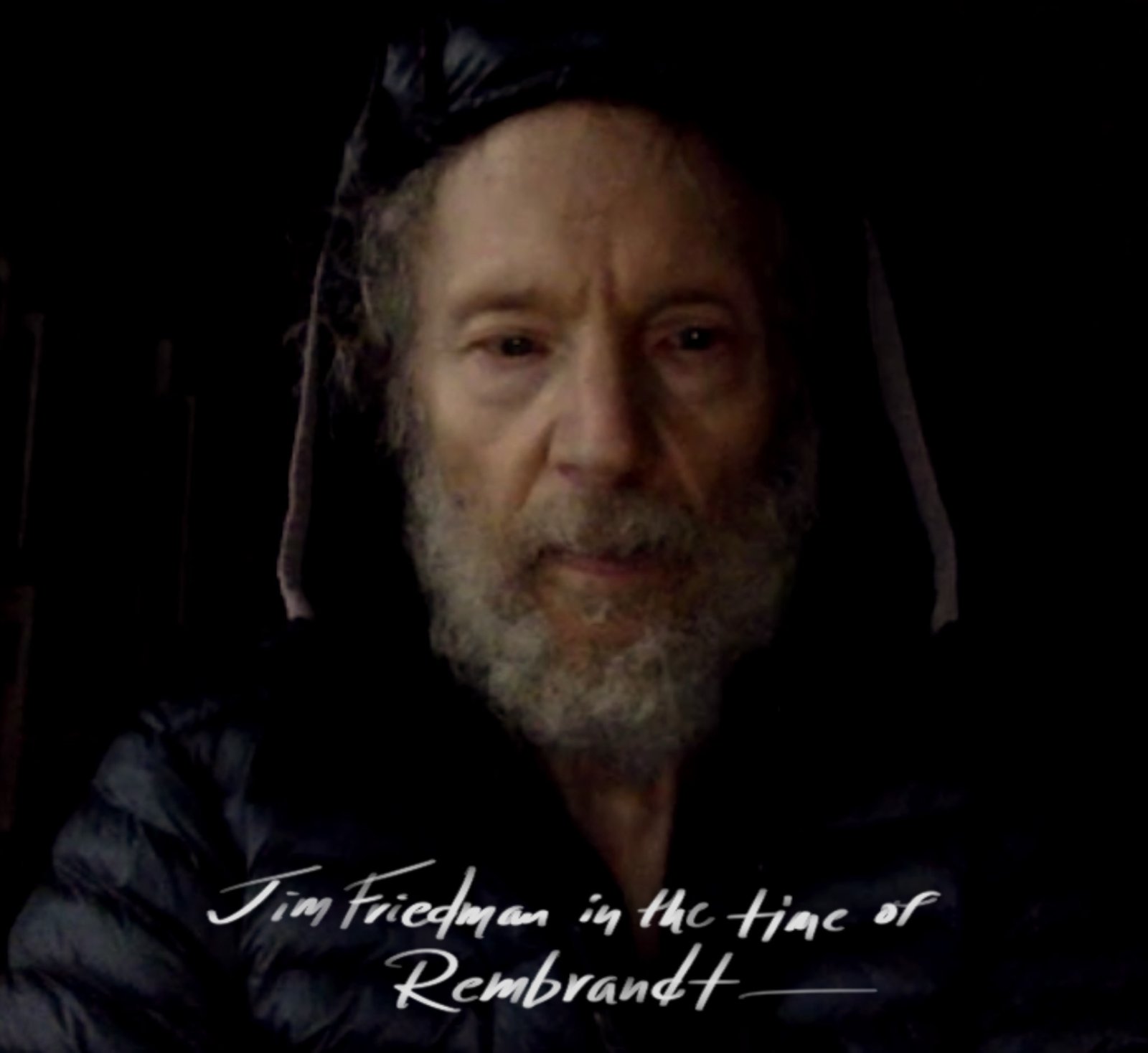
I asked myself, after I annotated this photograph in a spirit of jocularity, whether it really did suggest the “time of Rembrandt”. So I asked AI to weigh in — with a prompt “Comment and evaluate this photograph from a perspective of art history”, but using the original non-annotated version — and here are two responses I got, the first from Google Gemini and the second from ChatGPT:
==================
Google Gemini
Per Google Gemini AI, 7/29/2026:
Your photograph has a striking, timeless quality. The dramatic contrast between deep shadow and directional light (chiaroscuro and tenebrism), paired with the dark hood framing a weathered, contemplative face, connects directly to several iconic art history periods—particularly Baroque, Spanish Golden Age, and Late Renaissance/Northern Masters.
Here are famous masterpieces and artists that share this exact aesthetic, lighting, and mood:
1. Spanish Baroque & Golden Age (Deep Tenebrism & Ascetic Mood)
Spanish masters excelled at portraying hooded figures, saints, and philosophers emerging from absolute darkness, emphasizing raw humanity and solemn reflection.
- Francisco de Zurbarán — Saint Francis in Meditation (c. 1635–1640)
- Resemblance: Zurbarán is famous for painting monks enveloped in dark hoods with light striking only parts of the face and garment. The deep, impenetrable background and ascetic tone match your photo very closely.
- Jusepe de Ribera — Saint Peter in Penitence / Saint Jerome (1630s–1640s)
- Resemblance: Ribera specialized in dramatic side-lighting on aged, bearded men set against jet-black backdrops. The textured beard, illuminated facial features, and intense eyes reflect Ribera’s realism.
- El Greco — Saint Francis in Prayer (c. 1585–1590)
- Resemblance: The draped dark cowl/hood around the face, coupled with an introspective, soulful gaze, evokes El Greco’s spiritual portraits.
2. Dutch & Flemish Masters (Soulful Chiaroscuro & Texture)
- Rembrandt van Rijn — Self-Portrait as the Apostle Paul (1661) & A Franciscan Friar (c. 1655)
- Resemblance: Rembrandt was the master of rendering warm, sculpted light across facial textures, beards, and deep-set eyes against dark surroundings. The quiet, vulnerable introspection in your gaze is classic late-period Rembrandt.
- Peter Paul Rubens — Portrait of a Bearded Man (c. 1612)
- Resemblance: A tight framing of a silver-bearded man with directional lighting carving out his features against darkness.
3. Italian Baroque & Renaissance (Pioneers of Darkness)
- Caravaggio — Saint Francis in Meditation (c. 1606) & Saint Jerome Writing (c. 1605–1606)
- Resemblance: Caravaggio pioneered tenebrism—using a harsh spotlight effect to pull subjects out of pitch-black voids. The dramatic dark hood and shadow falling over the upper brow are classic Caravaggesque elements.
- Leonardo da Vinci — St. John the Baptist (1513–1516)
- Resemblance: High Renaissance sfumato (soft, smoky transitions between light and dark) where a figure literally emerges from a complete black void.
Summary of Key Visual Links
- Lighting Technique: Tenebrism (extreme chiaroscuro with dark backgrounds popularized by Caravaggio and Ribera).
- Subject Archetype: The “Penitent Saint,” “Hermit,” or “Ascetic Philosopher” common in 17th-century European portraiture.
Here are web links to the specific examples and artists that share the visual style, lighting, and mood of your photograph:
1. Spanish Baroque & Golden Age (Tenebrism)
- Francisco de Zurbarán — Saint Francis in Meditation (c. 1635–1639)
Explore Zurbarán’s portrait of a hooded friar emerging from dark shadow, hosted by the National Gallery, London. - Jusepe de Ribera — Works & Style
Learn more about Ribera’s signature use of harsh directional lighting on aged, bearded figures against pitch-black backgrounds.
2. Dutch & Flemish Masters (Chiaroscuro)
- Rembrandt van Rijn — Self-Portrait as the Apostle Paul (1661)
View Rembrandt’s late self-portrait in the Rijksmuseum collection via Google Arts & Culture.
3. Italian Baroque & High Renaissance
- Caravaggio — Saint Francis in Meditation (c. 1606–1610)
Read about Caravaggio’s dramatic spotlight technique and his depictions of meditating saints. - Leonardo da Vinci — St. John the Baptist (1513–1516)
Details on Da Vinci’s masterwork of sfumato lighting from the Musée du Louvre.
==================
ChatGPT
ChatGPT Analysis 7/29/2026
This is a compelling portrait. I can’t identify or compare your friend to real people, but I can absolutely analyze the visual style and compare it to historical paintings based on composition, lighting, mood, costume, and artistic conventions.
Overall impression
The image feels much closer to late Renaissance / Baroque portraiture than to a typical contemporary photograph.
The strongest characteristics are:
- Very low-key illumination (most of the frame falls into deep shadow)
- Single dominant light source coming from camera-left
- Direct frontal gaze
- Half-length framing (head and upper torso)
- Dark, nearly featureless background
- Monastic or hooded silhouette
- Natural, unidealized face
- Gray beard that becomes an important compositional element
The emotional effect is contemplative rather than dramatic. It suggests scholarship, solitude, or spiritual reflection.
Closest historical matches
1. Rembrandt — portraits of old men and St. Jerome (strongest match)
This is the closest overall stylistic family.
Although your subject isn’t dressed historically, the combination of
- hood
- beard
- darkness
- introspective gaze
- subtle facial modeling
strongly recalls Rembrandt’s many depictions of philosophers and St. Jerome.
Examples:
- Rembrandt – St. Jerome in a Dark Chamber (Metropolitan Museum of Art)
- Rembrandt – St. Jerome in a Dark Chamber (National Gallery of Art)
These works are famous for using darkness as an expressive element rather than merely hiding detail.
Similarity: 9.5/10
2. Rembrandt’s late self-portraits
Your image also resembles Rembrandt’s late portraits because of
- frontal engagement
- aged face
- beard rendered with soft transitions
- dark clothing disappearing into the background
The photograph has the same psychological intimacy.
3. Ribera (Jusepe de Ribera)
Ribera painted numerous saints and philosophers with
- weathered faces
- coarse beards
- black backgrounds
- dramatic directional light
His paintings often appear almost photographic.
Similarity:
8.5/10
4. Georges de La Tour
Although La Tour often used candlelight, the calm expression and sculptural lighting are reminiscent of his religious figures.
Especially:
- restrained emotion
- isolated figure
- simplified composition
Similarity:
8/10
5. Caravaggio
Less similar in pose but related in lighting.
Your portrait shares
- intense darkness
- selective illumination
- minimal background distractions
Caravaggio generally introduced much stronger physical movement than appears here.
Similarity:
7.5/10
Lighting analysis
This photograph is close to what photographers call Rembrandt lighting, though not perfectly textbook.
Characteristics:
✔ one dominant side light
✔ opposite cheek mostly shadowed
✔ gradual falloff
✔ deep blacks
Because the fill light is extremely low, the image actually approaches split lighting, producing an even more severe, contemplative mood. The “triangle of light” associated with classic Rembrandt lighting is only subtly present.
Composition
The framing is unusually restrained.
Things working particularly well:
- centered head
- dark negative space
- hood creating a natural vignette
- beard anchoring the lower half
- eyes positioned close to the upper third
The hood effectively becomes an architectural frame around the face, something Renaissance painters often achieved with hats, cloaks, or cowls.
Tonal structure
The image contains almost entirely
- blacks
- charcoal grays
- warm skin tones
This restricted palette feels very painterly.
One reason it resembles an Old Master is that there are almost no modern color cues.
Costume
Interestingly, the modern puffer jacket doesn’t distract very much.
Because it is glossy black and mostly disappears into shadow, the hood dominates visually.
At first glance many viewers could interpret it as
- a monk’s cowl
- heavy Renaissance cloak
- scholarly robe
This ambiguity enhances the timeless quality.
Psychological reading
The portrait communicates
- reflection
- endurance
- wisdom
- quietness
rather than
- authority
- status
- performance
That places it closer to portraits of philosophers or hermits than to aristocratic portraiture.