This week I watched five hours of PBS TV’s AMERICAN MASTERS “You Must Remember This” series on the history of Warner Bros. and its films. I thought about how much my still photography has been informed by the likes of Orson Welles, Film Noir, and Sven Nykvist’s work with Ingmar Bergman and others. And what I have learned by carefully watching (some) television. Following the last episode of “You Must Remember This” was a showing on my local station of “Casablanca”. I hadn’t seen it for a long time, so I was ready to go one more time, until Kim talked me out of it. It was getting pretty late, after all, and I can always study the camera work and individual scenes anytime by dusting if off from my DVD library.
But as I drifted off to sleep, I found myself continuing to think about TV, and remembered Jerry Mander’s FOUR ARGUMENTS FOR THE ELIMINATION OF TELEVISION that was published in the late 70s. An executive summary of those arguments might be as follows, quoting from the book:
Argument One–The Mediation of Experience
“As humans have moved into totally artificial environments, our direct contact with any knowledge of the planet has been snapped. Disconnected, like astronauts floating in space, we cannot know up from down or truth from fiction. Conditions are appropriate for the implantation of arbitrary realities. Television is one recent example of this, a serious one, since it greatly accelerates the problem.”
. . .
Argument Two–The Colonization of Experience
“It is no accident that television has been dominated by a handful of corporate powers. Neither is it accidental that television has been used to re-create human beings into a new form that matches the artificial, commercial environment. A conspiracy of technological and economic factors made this inevitable and continue to do so.”
. . .
Argument Three–Effects of Television on the Human Being
“Television technology produces neuro-physiological responses in the people who watch it. It may create illness, it certainly produces confusion and submission to external imagery. Taken together, the effects condition for autocratic control.”
. . .
Argument Four–The Inherent Biases of Television
“Along with the venality of its controllers, the technology of television predetermines the boundaries of its content. Some information can be conveyed completely, some partially, some not at all. The most effective telecommunications are the gross, simplified linear messages and programs which conveniently fit the purposes of the medium’s commercial controllers. Television’s highest potential is advertising. This cannot be changed. The bias is inherent in the technology.”
These arguments continue to be rather compelling but very controversial to this day, of course. When I first read Mander’s book, I mostly watched public television shows like “Nova” and “The MacNeil-Lehrer News Hour” — and Star Trek. I was warned, when my kids came along, that I needed to gird against the temptation to use TV as an electronic babysitter. Right.
I still watch mostly public television, and perhaps even more so as a grow older. But I have discovered that for Sheer Entertainment, it is hard to beat these four “counter arguments”, listed more or less in order of personal preference:
The first three are sometimes characterized as soap opera in the sixties, in space, and on a desert island, respectively; the fourth is my daughter’s favorite, and now one of mine, too. I believe you can watch the last two (ABC TV) completely online as well, while snippets and previews can be seen online for Mad Men and BSG.
Perhaps I will have to do some research and see whether Mander or anyone else has almost certainly extended the elimination arguments to the Internet as well …
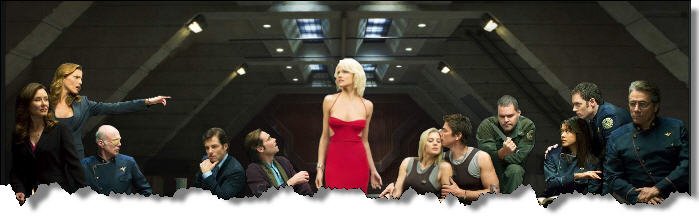
And finally, I must share with you a chunk of this incredible tableau that I ripped from the BSG (Battlestar Galactica) site: