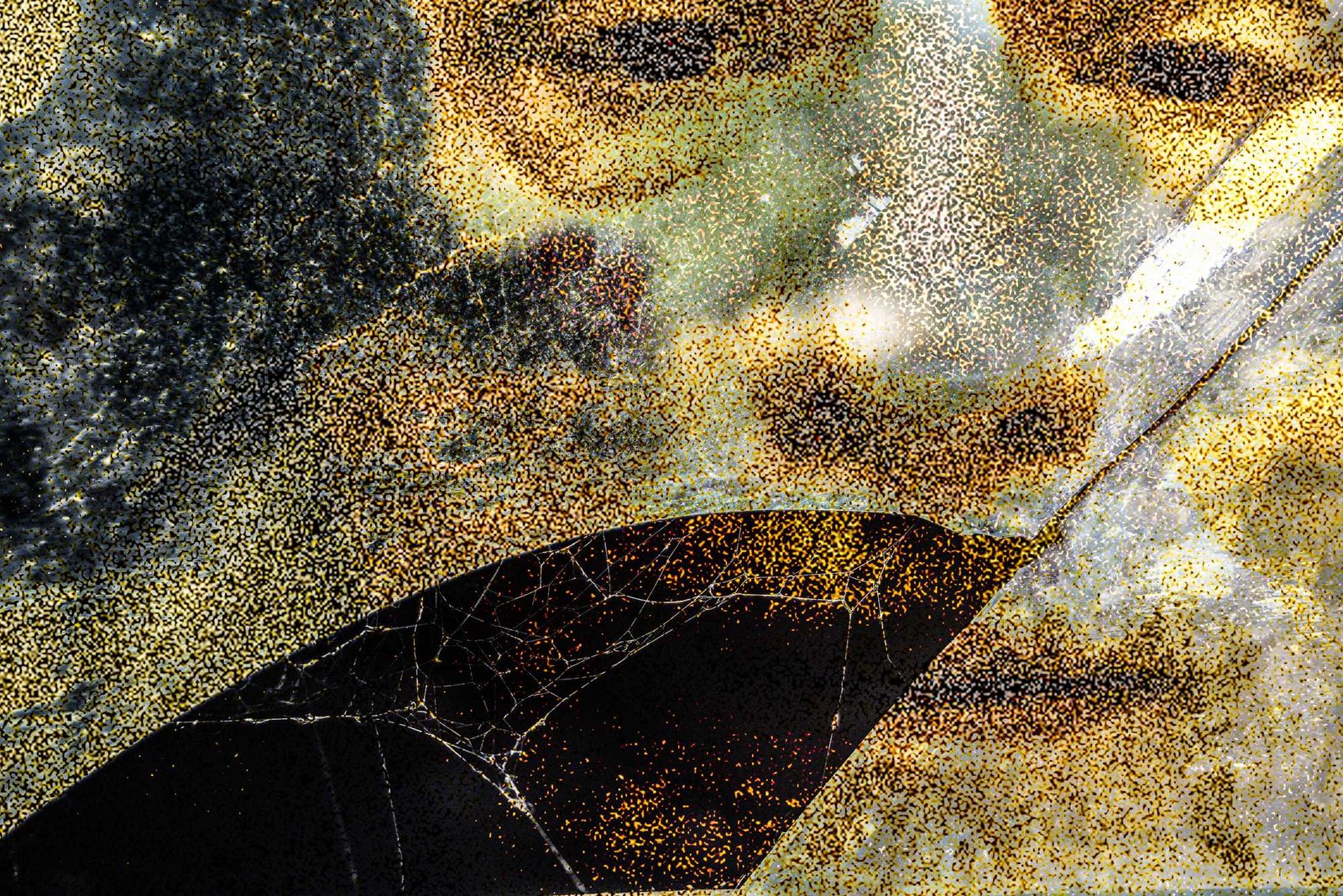
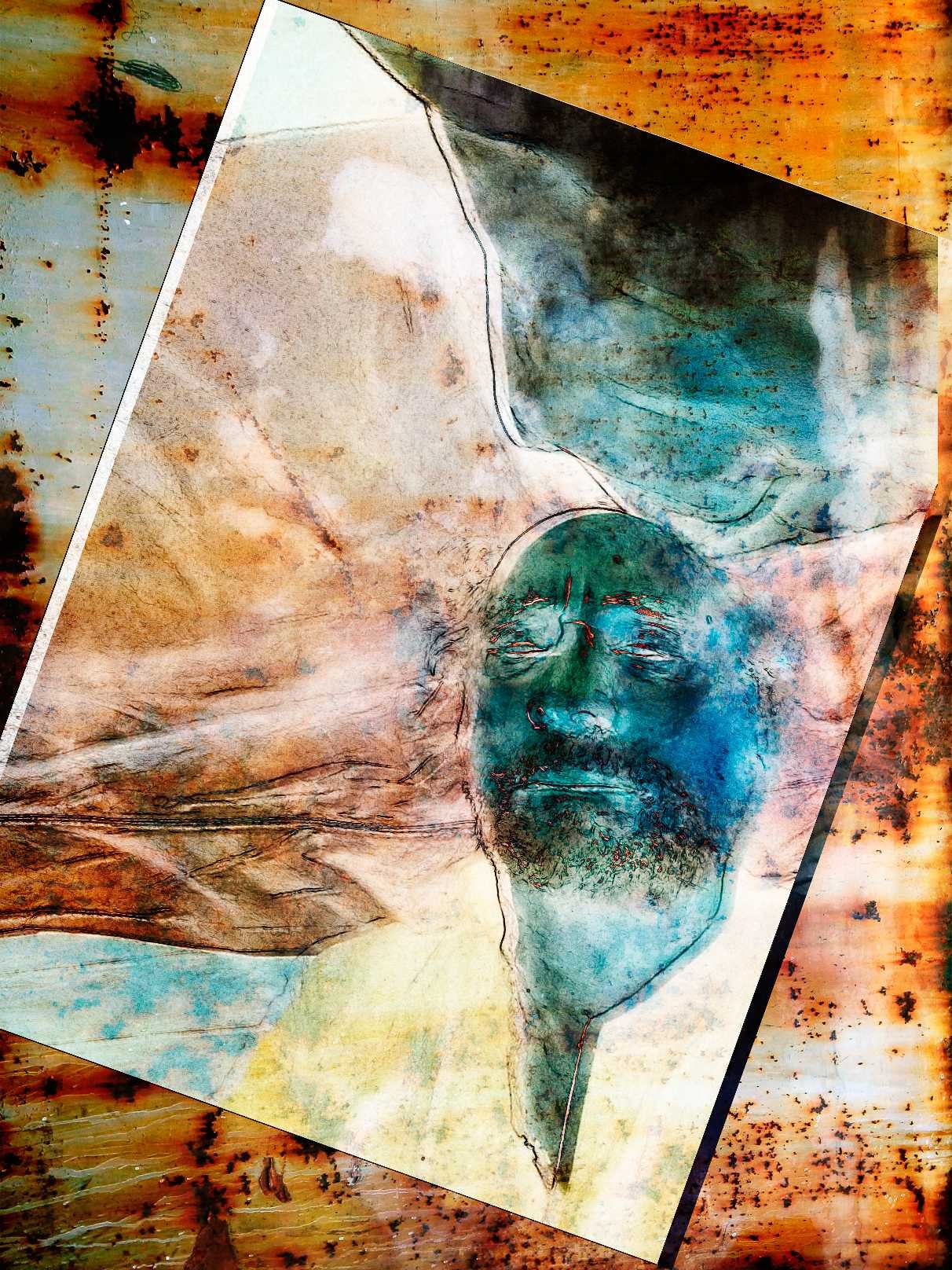
Brian in Colorado (1974)

Another previously-forgotten archive find …

Posted in my stuff | Comments Off on Brian in Colorado (1974)

Putting a Hex On Things, Like Crow #8303

Today, I started experimenting with deliberate corruption of some image files.  It all started when I realized that my text programming editor would open (but not save) graphic files, like JPGs.  I had actually used that feature a little earlier when I made a screen capture of a JPG opened in that way, exposing its underlying hex/ANSI/OEM — I’ll try not to get into the weeds with this — by overlaying a JPG made from a screen capture of a dump of the hexadecimal code on a standard PSD file.  But now… I have started with this, my most recent posting — also seen here — of a “standard” straight JPG graphics file, my latest addition to a collection of images of crows and skies:

The next step was to use my hex programming editor* — stuff like this was in my toolkit during my thirty-five or thereabouts years as a computer programmer — to expose the underlying hex code and mess with it in a damaging way, so as to delete sections of code or cut and paste pieces of code randomly. This involves flying in the blind, as you cannot see in realtime the effects of the changes, but instead have to save the damaged file and hope you can open the result, itself an iffy proposition. Here below are a few variations that resulted from my random ravages of the code.

And here is a version that also incorporates layers of the textual representation of the hex code itself (like an exoskeleton) with yet another more conventional image from my Coronavirus series.

I intend to keep after this for a bit, to see if anything of interest arises. (I am reminded of an occasional technique I employ for my modern approach to “street photography” in which I hold the camera at 90 degrees at hip level and trip the shutter as I walk down sidewalks and across intersections, all without using the viewfinder or, often, not even looking in the same direction as the lens is pointing.  Maybe someday I will show some of those, too.)


* As most everyone probably knows, our digital world is run by binary on-off switches, zeros and ones.  While the earliest programming was literally done by directly flipping these switches, practical programming (and transistors and circuit miniaturization) quickly evolved to use systems of abstraction to get the job done.  A basic level of this ladder of abstraction is to use the hexadecimal number system (base 16) for better efficiency.  Modern programming languages are at a tremendous remove from the early coding tools and methods, but hex editors still have their place for repair of corrupted files and in computer forensics.

UPDATE, 4/5/21: After a little interwebs research today, I have discovered that my newfound technique is by no means original, as programming-oriented people have discovered such artifacts and bastardizations years ago, and some have even produced “glitch art”, particularly by corrupting frames of video files.

Posted in experimental, my stuff | Comments Off on Putting a Hex On Things, Like Crow #8303

Crow #8303

Posted in my stuff, Wired Skies | Comments Off on Crow #8303

Jim Friedman and a Polaroid by Judy Dater (1973)

[temp v.7, 1973-01-02 (11 of 39)-E7]

Posted in my stuff, people/portraits, photographers & exhibitions | Comments Off on Jim Friedman and a Polaroid by Judy Dater (1973)

LAX (1961)

August 1961, about to depart from Los Angeles International Airport and return to the Midwest.  Second summer in California; first in L.A.  Still using the Kodak Brownie.  Photographer unknown: must have been either my brother Dennis or my uncle’s girlfriend Rene …

Posted in Uncategorized | Comments Off on LAX (1961)

Flight Over Maple, Recursive Variation #1

In continuation of the Flight Over Maple project, itself a fork of the Pandemic Portfolio, today we blend the original image with itself by embedding its own normally-unseen code that represents its graphic self, into its normal manifestation.  Perhaps demonstrating, once again, that this is just a photograph, and not the subject itself.  Or does it?

Posted in my stuff | Comments Off on Flight Over Maple, Recursive Variation #1

Fourth Avenue, During the Pandemic

Posted in automobilia, my stuff | Comments Off on Fourth Avenue, During the Pandemic

Porsche SC

Posted in automobilia, my stuff | Comments Off on Porsche SC

Wired Skies at the Oregon/Washington Border

Posted in my stuff, Windshield Photography, Wired Skies | Comments Off on Wired Skies at the Oregon/Washington Border

Francesca Woodman, Explained

“The black and white photograph Untitled, from Angel Series, Rome, Italy 1977 depicts the interior of a rundown building, with a doorframe taking up a large portion of the image. Through the doorframe can be seen two figures. The figure to the left stands behind a large crumpled sheet of paper, with only their feet and a very faint impression of their body visible. The shape is blurred with movement. The second figure, on the right-hand side, appears to be crouched behind a small rectangular form (perhaps a wooden board or block), with only a hand visible from the left side. A bright light from the left illuminates the otherwise empty space.”

Francesa Woodman, Angel Series, Rome 1977 (Lawrence Hathaway text overlay modifications)

Some time ago I happened to have been thinking of the photographs of, among others, Francesa Woodman. So I fired up my web browser to refresh my memory of her work. One of the pages I happened upon was at the British Tate museum and gallery website, as linked immediately below.

https://www.tate.org.uk/art/artworks/woodman-untitled-from-angel-series-rome-italy-ar00354

I noted that the Tate pages of artists’ individual pieces presented a “Summary” section which provided a literal description of the particular artwork as though one were describing what they were seeing to someone who was unable to see the piece. In this case, the Summary text on the Tate page was as follows:

The black and white photograph Untitled, from Angel Series, Rome, Italy 1977 depicts the interior of a rundown building, with a doorframe taking up a large portion of the image. Through the doorframe can be seen two figures. The figure to the left stands behind a large crumpled sheet of paper, with only their feet and a very faint impression of their body visible. The shape is blurred with movement. The second figure, on the right-hand side, appears to be crouched behind a small rectangular form (perhaps a wooden board or block), with only a hand visible from the left side. A bright light from the left illuminates the otherwise empty space.

This, of course, reminded me of “Alt-Text”, a feature of website design and presentation that I had used since my days in the early 1990s of working with the HyperText Markup Language (HTML), as a facet of the computer programming I had been doing since the late 1970s. “Alt” in HTML is an attribute associated with an image to convey information about that image (and is invisible to usual web browsers). The Alt attribute was commonly used to trigger “screen reader” software used by blind or visually impaired Web users to translate Web pages into auditory and tactile cues, and would specifically provide such users with information about images that they would otherwise be unaware of.

While the Tate website no longer uses Alt-Text strictly in this manner (modern programming technologies now provide many more versatile techniques), I wondered why the Tate chose to present its pieces in such a way. As I have been experimenting for a time with overlaying and imbedding text in some of my photographs, I tried to fuse the Woodman piece with the Tate textual description, with the following result (also seen at the top of this post):

Francesa Woodman, Angel Series, Rome 1977 (with Lawrence Hathaway modifications)


I suppose that all this is by way of introduction to the “Experimental” section of this site where I am working through some new processes and approaches, one of which happens to entail overlaying, embedding or somehow infusing some of my photographs with textual material.

Posted in experimental, photographers & exhibitions | Comments Off on Francesca Woodman, Explained